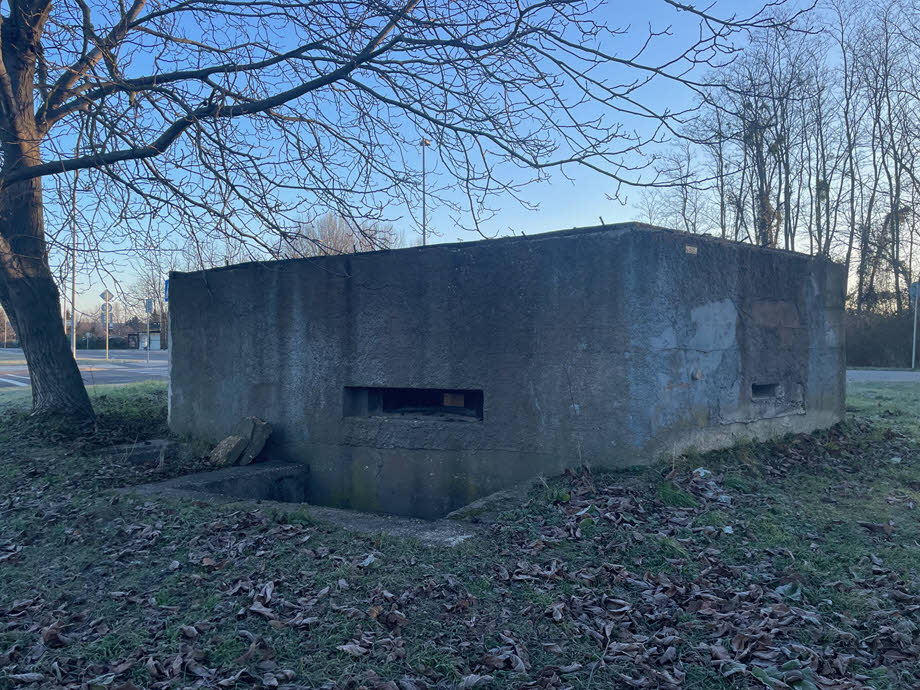
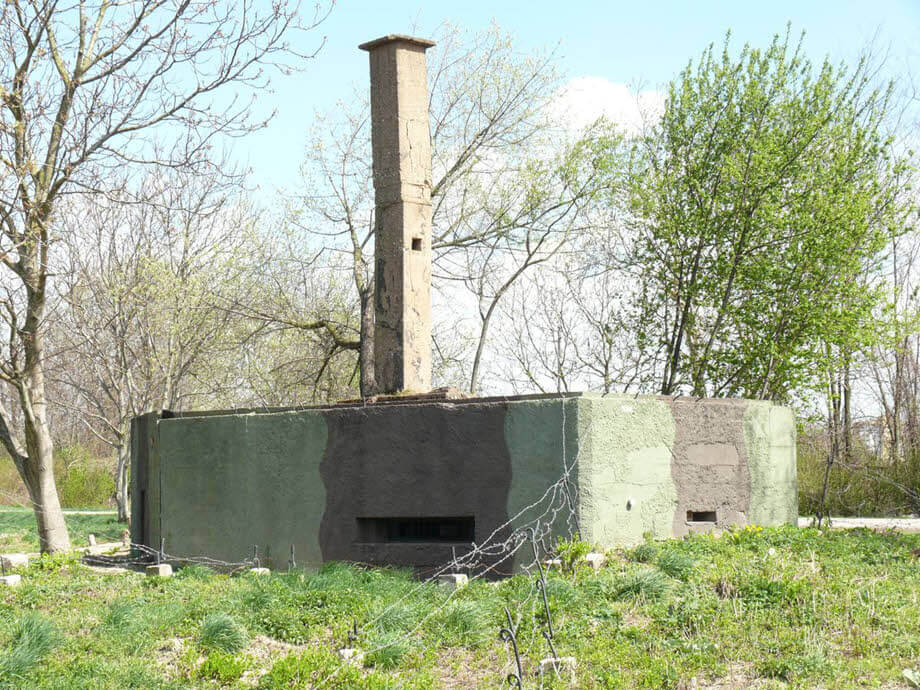
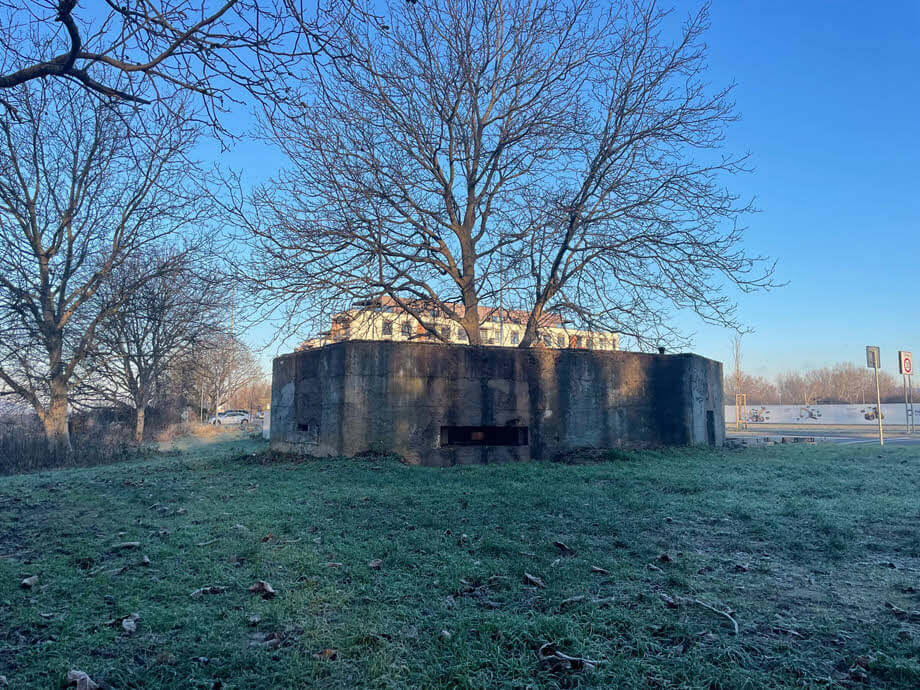
This is a smaller bunker from the first line of structures built to defend Petržalka in 1933–35. Its interior is very similar to that of B-S 7, although an extension was later added, making it larger. A guardhouse was built on the roof, and its chimney initially survived but, sadly, was removed in 2010. The bunker stands on Kopčianska Street, by the turn-off to the new Nesto district and the road leading across the border to the Austrian village of Kittsee, from which the bunker takes its name. It was the second bunker built in Petržalka. B-S 9 is part of the line of nine bunkers with which General Josef Šnejdárek had Petržalka fortified in 1933–35. The main purpose was defence against an attack from Hungary, although as early as 1936 these bunkers became part of the newly launched construction of a line of new structures intended to protect the territory against Germany as well. Like B-S 7, it had only one room with three embrasures, the front one of which was converted into a narrow observation slit overlooking the road from Kittsee. The embrasures in the old structures were originally intended for older Austro-Hungarian water-cooled Schwarzlose machine guns, or their Czechoslovak versions, known as 7/24 machine guns. In all the older structures, the embrasures were modified and fitted with mounts for the modern, previously mentioned air-cooled Model 35 and Model 37 machine guns. Together with B-S 4, B-S 7, and B-S 8, B-S 9 is owned by the Military History Institute. These are the only bunkers the state has retained. Bunker B-S 9 is currently closed because of the ongoing construction of the Nesto district. In the future, however, there are plans to use the site for cultural and tourism purposes.

Military bunkers

Bunker B-S 9 Kittsee
-

-